If you have been diagnosed with SAPS, you probably have difficulty doing everyday tasks such as putting on a shirt. This post will explain what this condition is; how long it lasts and how your osteopath can help you on your road towards recovery.
What is SAPS?
To discuss SAPS we will go through the anatomy, explain the original understanding of SAPS and what research has found recently.
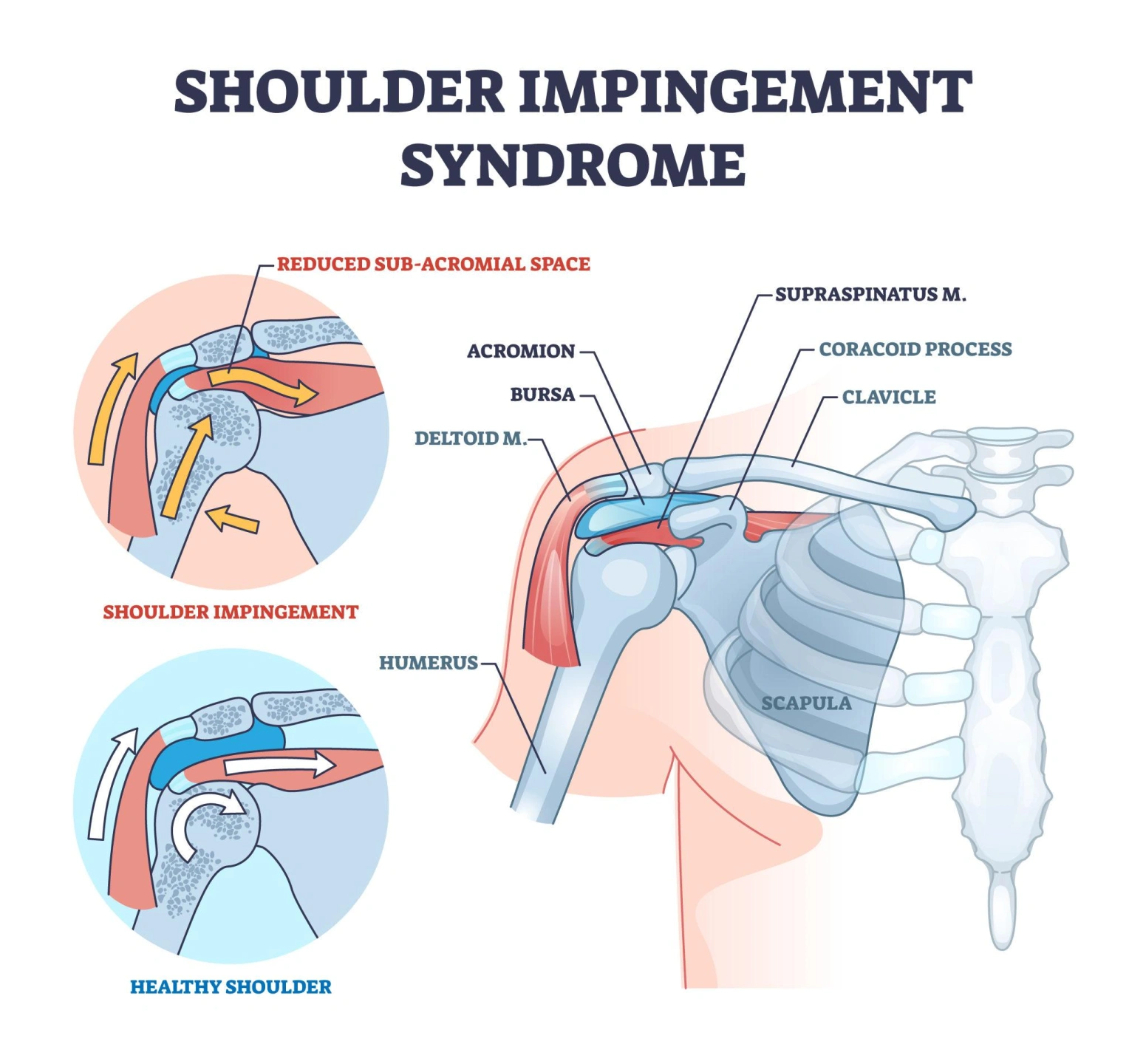
The shoulder joint is where the shoulder blade or “scapula” attaches to the head of the “humerus” which is the long bone of your upper arm. The acromion is a bit of bone that juts out of the shoulder blade which you can feel on the outer edge of your shoulder. There is a space that is under the acromion where there are tendons that attach from the muscles of the shoulder blade to the head of the humerus. A bursa (fluid filled sac) acts as a cushion between the tendons and the acromion.
Originally SAPS was thought to occur because the structures get “caught” or “impinged” in this narrow space, hence why this condition used to be called “subacromial impingement syndrome”. New evidence revealed that standard surgery which enlarges the space was no better than placebo or “mock” surgery (Karjalainen et al., 2019; Paavola et al., 2021) indicating that the impingement theory is a “myth” thereby renaming the condition to be “subacromial pain syndrome”. Surgical guidelines now say not to undergo surgery (Vandvik et al., 2019).
The videos on this site visualise the previous understanding of the condition.
How can it affect you?
Having SAPS may hinder your abilities to do everyday activities like washing dishes, carrying, driving, washing hair, preparing food, opening a jar and sexual activities (Alizadehkhaiyat et al., 2017).
The duration of SAPS can last from under 6 weeks to over 2 years. Initiating treatment and management early will likely improve outcomes (Diercks et al., 2014) and decrease the impacts of poor mental health (Overbeek et al., 2021). If you do have longstanding pain, it is suggested that psychological help can improve treatment outcomes (Overbeek et al., 2021).
Fear of movement can develop which hinders recovery. A study found that higher pain levels; inability to perform everyday activities; depression and poor sleep contribute to the development of fear of movement (Karartı et al., 2023). An osteopath can help you feel empowered by encouraging safe movements and identifying which activities to avoid (Montpetit-Tourangeau et al., 2023).
Do corticosteroid injections help?
One of the reasons your osteopath may refer you to GP is to assess your need for an anti-inflammatory injection. It is important to understand that this is a medication for short-term relief and may provide a window of opportunity to implement proper exercise to allow for correct healing, it will not “fix” the problem alone (Gaujoux-Viala et al., 2009; Raeesi et al., 2022)
New research shows that non-steroidal anti-inflammatory (NSAID) injections and very low volume corticosteroid injections have similar effects to standard corticosteroid injections with less potential side effects (Apivatgaroon et al., 2023; Ziradkar et al., 2023). These interventions will likely become more popular in the future as a result.
How can an osteopath help you?
Your osteopath can assess you for the correct diagnosis. This will consist of important questioning, and tests.
Your osteopath can provide manual therapy such as massage and gentle manipulations of the shoulder to reduce pain and improve your range of motion which can facilitate your ability to perform exercise (Pieters et al., 2020).
There is extensive research verifying that exercise is of benefit to reduce pain and improve function of SAPS (Pieters et al., 2020). It is recommended to progress the exercises over 3 months (Clausen et al., 2021). An osteopath can tailor exercise programs to your specific functional needs and will likely have better outcomes than doing exercise on your own (Liaghat et al., 2021).
The first video contains beginner exercises to work the large shoulder blade muscles which can help with SAPS (Pieters et al., 2020; Yun et al., 2020).
Do 3 sets of 10 to 15 repetitions of each of these exercises 2 to 3 times a week or as tolerated.
If any exercise is painful, you may do it up until a 3/10 in pain 0 being no pain and 10 being the worst pain imaginable. Pushing through the pain may make the condition worse, so if you can’t do it yet, skip to the next one.
The next exercise video is a supine pectoral stretch that opens the front of the chest to assist with optimal movement of the shoulder blade (Pieters et al., 2020).
Do this exercise for 2 minutes daily for 5 weeks.
You are already recovering; your body is healing as we speak. Hopefully this post is encouraging and will lead you taking good steps towards an active recovery.